
Original author: jaypume
Original lecture video: https://www.bilibili.com/video/BV1hg4y1b78L
Original post: https://github.com/jaypume/article/blob/main/sedna/边云协同AI框架Sedna源码解析/README.MD
Reposted here for my own study, easier to look up.
KubeEdge-Sedna overview
Sedna is a cloud–edge collaborative AI project incubated in KubeEdge SIG AI. On top of KubeEdge’s cloud–edge abilities, Sedna can do collaborative training and inference across cloud and edge: joint inference, incremental learning, federated learning, lifelong learning, etc. It supports common AI frameworks — TensorFlow / Pytorch / MindSpore — so existing AI apps can move over and pick up cloud–edge train/infer, with gains on cost, model quality, and data privacy.
Project home:
https://github.com/kubeedge/sedna
Docs:
Architecture
Sedna’s cloud–edge collab sits on these KubeEdge pieces:
- Unified orchestration of apps across cloud and edge
- Router: reliable control-plane message channel cloud–edge
- EdgeMesh: data-plane service discovery and traffic across cloud and edge
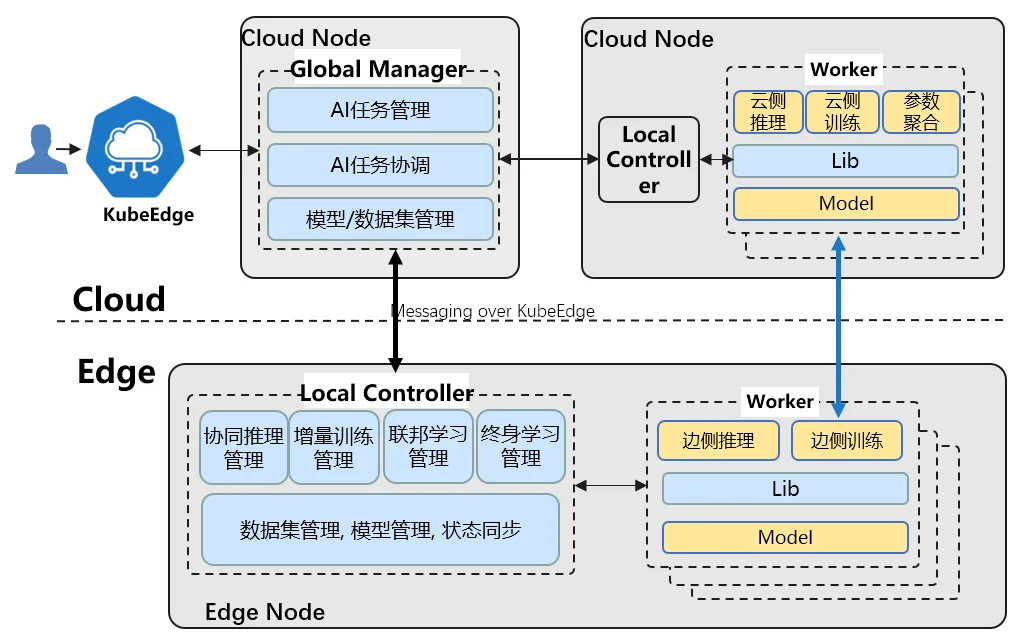
Basic components:
- GlobalManager
- Unified management of cloud–edge AI jobs
- Cross cloud–edge coordination
- Central config
- LocalController
- Local flow control of cloud–edge AI jobs
- Local generic management: models, datasets, status sync, etc.
- Lib
- For AI and app developers: expose cloud–edge AI features to the app
- Worker
- Run train or infer, programs built on existing AI frameworks
- Different features → different worker groups; workers can sit on edge or cloud and collaborate
Repo layout
| Dir | What |
|---|---|
| .github | Sedna GitHub CI/CD |
| LICENSES | Sedna licenses and vendor licenses |
| build | Dockerfiles for GM/LC; generated CRD yaml; CRD samples |
| cmd | GM/LC entrypoints |
| components | Monitoring and UI |
| docs | Proposals and install docs |
| examples | Joint infer, incremental, lifelong, federated samples |
| hack | Codegen and other dev scripts |
| lib | Sedna Library, Python deps for cloud–edge AI apps |
| pkg | API defs; generated client-go; GM/LC core |
| scripts | Install scripts for users |
| test | E2E tests and tools |
| vendor | Third-party source |
Sedna control plane source (Go)
GM: Global Manager
GM, a Kubernetes operator
What’s an operator?
An Operator is an application-specific controller that extends the Kubernetes API to create, configure and manage instances of complex stateful applications on behalf of a Kubernetes user. It builds upon the basic Kubernetes resource and controller concepts, but also includes domain or application-specific knowledge to automate common tasks better managed by computers. 1
For Sedna, GM decides how workers are configured and started, how they collaborate, how jobs move between stages. So: Sedna GM is the controller for the domain “cloud–edge collaborative AI apps”.
The following components form the three main parts of an operator:
- API: The data that describes the operand’s configuration. The API includes:
- Custom resource definition (CRD), which defines a schema of settings available for configuring the operand.
- Programmatic API, which defines the same data schema as the CRD and is implemented using the operator’s programming language, such as Go.
- Custom resource (CR), which specifies values for the settings defined by the CRD; these values describe the configuration of an operand.
- Controller: The brains of the operator. The controller creates managed resources based on the description in the custom resource; controllers are implemented using the operator’s programming language, such as Go. 2
From that Red Hat definition, the important operator pieces are CRD, API, CR, and Controller.
Sedna GM Operator sketch:
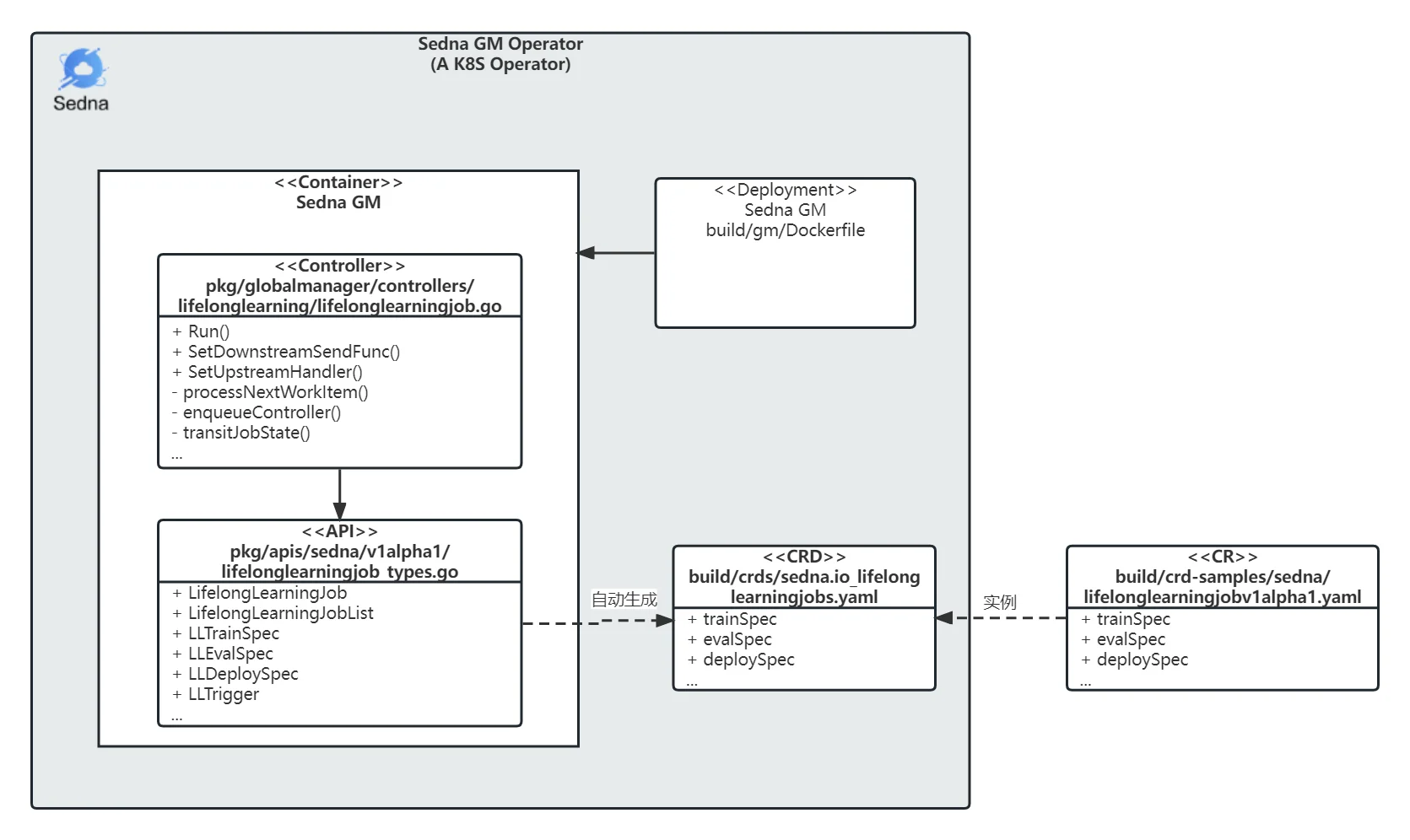
The next sections follow those pieces: CR, CRD, API, Controller. Controller is the main logic.
CR
Sedna supports joint inference, incremental learning, lifelong learning, federated learning. To keep the walkthrough tractable this post uses lifelong learning. The other three share a lot; you can map them.
CR sample
A lifelong-learning CR sample. You can kubectl-create from it. Full steps here. Fields:
- dataset: dataset object name; the dataset is also a CR.
- trainSpec: train worker start params — image, env, etc.
- trigger: when to start the train worker.
- evalSpec: eval worker start params.
- deploySpec: infer worker start params.
- outputDir: where trained models go.
build/crd-samples/sedna/lifelonglearningjobv1alpha1.yaml
apiVersion: sedna.io/v1alpha1
kind: LifelongLearningJob
metadata:
  name: atcii-classifier-demo
spec:
  dataset:
    name: "lifelong-dataset"
    trainProb: 0.8
  trainSpec:
    template:
      spec:
        nodeName:  "edge-node"
        containers:
          - image: kubeedge/sedna-example-lifelong-learning-atcii-classifier:v0.3.0
            name:  train-worker
            imagePullPolicy: IfNotPresent
            args: ["train.py"]
            env:
              - name: "early_stopping_rounds"
                value: "100"
              - name: "metric_name"
                value: "mlogloss"
    trigger:
      checkPeriodSeconds: 60
      timer:
        start: 02:00
        end: 24:00
      condition:
        operator: ">"
        threshold: 500
        metric: num_of_samples
  evalSpec:
    template:
      spec:
        nodeName:  "edge-node"
        containers:
          - image: kubeedge/sedna-example-lifelong-learning-atcii-classifier:v0.3.0
            name:  eval-worker
            imagePullPolicy: IfNotPresent
            args: ["eval.py"]
            env:
              - name: "metrics"
                value: "precision_score"
              - name: "metric_param"
                value: "{'average': 'micro'}"
              - name: "model_threshold"
                value: "0.5"
  deploySpec:
    template:
      spec:
        nodeName:  "edge-node"
        containers:
        - image: kubeedge/sedna-example-lifelong-learning-atcii-classifier:v0.3.0
          name:  infer-worker
          imagePullPolicy: IfNotPresent
          args: ["inference.py"]
          env:
          - name: "UT_SAVED_URL"
            value: "/ut_saved_url"
          - name: "infer_dataset_url"
            value: "/data/testData.csv"
          volumeMounts:
          - name: utdir
            mountPath: /ut_saved_url
          - name: inferdata
            mountPath: /data/
          resources:
            limits:
              memory: 2Gi
        volumes:
          - name: utdir
            hostPath:
              path: /lifelong/unseen_task/
              type: DirectoryOrCreate
          - name: inferdata
            hostPath:
              path:  /data/
              type: DirectoryOrCreate
  outputDir: "/output"
CRD
A CRD is the template for a CR. You have to declare the CRD on the cluster before you can create CRs. YAML can be written by hand or generated; for non-trivial CRDs, generate. Sedna uses kubebuilder’s controller-gen. make crds updates files under build/crds/. See crds: controller-gen in the Makefile.
To define a CRD you need group, version, kind — GVK. The object itself is a Resource. In OO terms Resource ≈ Object, Kind ≈ Class, so a Resource is an instance of a Kind. Lifelong learning GVR / GVK:
| Group | Version | Resource | Kind | |
|---|---|---|---|---|
| CRD | apiextensions.k8s.io | v1 | lifelonglearningjobs.sedna.io | CustomResourceDefinition |
| CR | sedna.io | v1alpha1 | lifelonglearningjob | LifelongLearningJob |
In K8s, resources are organized as REST URIs:
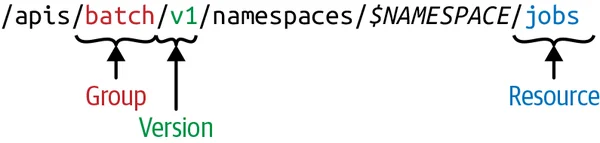
Once you know the pattern you can paste a REST URI and hit the cluster without kubectl / client-go. For example:
Lifelong-learning CRD via REST:
curl -k --cert ./client.crt --key ./client.key https://127.0.0.1:5443/apis/apiextensions.k8s.io/v1beta1/customresourcedefinitions/lifelonglearningjobs.sedna.ioLifelong-learning CR list via REST:
curl -k --cert ./client.crt --key ./client.key https://127.0.0.1:5443/apis/sedna.io/v1alpha1/lifelonglearningjobsIf a language has no official k8s client SDK, wrap these REST calls.
Sedna lifelong-learning CRD, fields to notice:
apiVersion: apiextensions.k8s.io/v1, all CRDs currently extend apiextensions.k8s.io/v1kind: CustomResourceDefinition, all CRDs inherit this Kindspec.group: sedna.io, custom resource group name is sedna.iospec.names.kind: LifelongLearningJob, the new typespec.names.shortNames: - ll, kubectl short namell
build/crds/sedna.io_lifelonglearningjobs.yaml
apiVersion: apiextensions.k8s.io/v1
kind: CustomResourceDefinition
metadata:
  annotations:
    controller-gen.kubebuilder.io/version: v0.4.1
  creationTimestamp: null
  name: lifelonglearningjobs.sedna.io
spec:
  group: sedna.io
  names:
    kind: LifelongLearningJob
    listKind: LifelongLearningJobList
    plural: lifelonglearningjobs
    shortNames:
    - ll
    singular: lifelonglearningjob
  scope: Namespaced
  versions:
  - name: v1alpha1
...
status:
  acceptedNames:
    kind: ""
    plural: ""
  conditions: []
  storedVersions: []
API
CRDs are generated — where’s the API that they come from?
pkg/apis/sedna/v1alpha1/lifelonglearningjob_types.go
package v1alpha1

import (
v1 "k8s.io/api/core/v1"
metav1 "k8s.io/apimachinery/pkg/apis/meta/v1"
)

// 这里展示了
// +genclient
// +k8s:deepcopy-gen:interfaces=k8s.io/apimachinery/pkg/runtime.Object
// +kubebuilder:resource:shortName=ll
// +kubebuilder:subresource:status

// 整体的LifelongLearningJob的API定义,主要包含Spec和Status定义,分别代表期望状态和实际状态。
type LifelongLearningJob struct {
metav1.TypeMeta   `json:",inline"`
metav1.ObjectMeta `json:"metadata"`
Spec              LLJobSpec   `json:"spec"`
Status            LLJobStatus `json:"status,omitempty"`
}

// 在创建LifelongLearningJob时候需要配置的参数;如果需要扩展终身学习字段的接口,可以在这里修改。
type LLJobSpec struct {
Dataset    LLDataset    `json:"dataset"`
TrainSpec  LLTrainSpec  `json:"trainSpec"`
EvalSpec   LLEvalSpec   `json:"evalSpec"`
DeploySpec LLDeploySpec `json:"deploySpec"`

// the credential referer for OutputDir
CredentialName string `json:"credentialName,omitempty"`
OutputDir      string `json:"outputDir"`
}

type LLDataset struct {
Name      string  `json:"name"`
TrainProb float64 `json:"trainProb"`
}

// 剩下还有一些结构体定义省略了。
Notes on that snippet:
// +kubebuilder...: flags for kubebuilder / codegentype LifelongLearningJob struct{...}: overall API, Spec (desired) and Status (actual)type LLJobSpec struct {...}: fields you set when creating the CR; extend lifelong-learning here
Joint infer / incremental / federated APIs live under pkg/apis/sedna/v1alpha1/ too.
Update client-go
After changing *_types.go:
bash hack/update-codegen.shGenerated code is in pkg/client:
➜  pkg tree client -L 2
client
├── clientset
│   └── versioned
├── informers
│   └── externalversions
└── listers
    └── sedna
client-go is used later in the Controller.
Update CRD defs
After changing *_types.go:
make crdsYAML lands in build/crds. Then kubectl apply again so the cluster picks up the new CRD.
Controller
Main lifelong-learning control is pkg/globalmanager/controllers/lifelonglearning/lifelonglearningjob.go — when train/eval workers fire, how params sync to the edge, etc.
Call flow before that logic, as pseudocode:
cmd/sedna-gm/sedna-gm.go/main() 【1】
pkg/globalmanager/controllers/manager.go/New() 【2】读取GM配置文件。
pkg/globalmanager/controllers/manager.go/Start() 【3】启动GM进程。
    - clientset.NewForConfig():【4】调用client-go生成了Sedna CRD client。
    - NewUpstreamController():【5】创建UpstreamController,每个GM进程有一个UpstreamController
    - uc.Run(stopCh):启动一个for循环协程,来处理
        - pkg/globalmanager/controllers/upstream.go/syncEdgeUpdate()
    - NewRegistry():【6】注册所有controller。
        - f.SetDownstreamSendFunc()【7】
            -> pkg/globalmanager/controllers/lifelonglearning/downstream.go
        - f.SetUpstreamHandler()【8】
            -> pkg/globalmanager/controllers/lifelonglearning/upstream.go/updateFromEdge()
        - f.Run()【9】
    - ws.ListenAndServe() 【10】
LifelongLearningJob Controller, following labels 1–10 above:
[1] main
sedna-gm.go is the GM entry: logs, app.NewControllerCommand() parses flags, starts the GM controller.
cmd/sedna-gm/sedna-gm.go
func main() {
   rand.Seed(time.Now().UnixNano())

   command := app.NewControllerCommand()
   logs.InitLogs()
   defer logs.FlushLogs()

   if err := command.Execute(); err != nil {
      os.Exit(1)
   }
}
[2] GM config
GM loads config: K8s cluster, websocket listen addr/port, KB service addr, etc.
pkg/globalmanager/controllers/manager.go
// New creates the controller manager
func New(cc *config.ControllerConfig) *Manager {
   config.InitConfigure(cc)
   return &Manager{
      Config: cc,
   }
}
pkg/globalmanager/config/config.go
// ControllerConfig indicates the config of controller
type ControllerConfig struct {
   // KubeAPIConfig indicates the kubernetes cluster info which controller will connected
   KubeConfig string `json:"kubeConfig,omitempty"`

   // Master indicates the address of the Kubernetes API server. Overrides any value in KubeConfig.
   // such as https://127.0.0.1:8443
   // default ""
   Master string `json:"master"`
   // Namespace indicates which namespace the controller listening to.
   // default ""
   Namespace string `json:"namespace,omitempty"`

   // websocket server config
   // Since the current limit of kubeedge(1.5), GM needs to build the websocket channel for communicating between GM and LCs.
   WebSocket WebSocket `json:"websocket,omitempty"`

   // lc config to info the worker
   LC LCConfig `json:"localController,omitempty"`

   // kb config to info the worker
   KB KBConfig `json:"knowledgeBaseServer,omitempty"`

   // period config min resync period
   // default 30s
   MinResyncPeriodSeconds int64 `json:"minResyncPeriodSeconds,omitempty"`
}
[3] GM init
Init Sedna CRD client, bind and start cloud–edge message handlers, start per-feature controllers, start websocket listen.
pkg/globalmanager/controllers/manager.go
// Start starts the controllers it has managed
func (m *Manager) Start() error {
   ...
   // 初始化Sedna CRD client,Controller会监听Sedna CR 增删改查的变化,并执行对应的处理逻辑。
   sednaClient, err := clientset.NewForConfig(kubecfg)

   ...
   sednaInformerFactory := sednainformers.NewSharedInformerFactoryWithOptions(sednaClient, genResyncPeriod(minResyncPeriod), sednainformers.WithNamespace(namespace))

   // 初始化UpstreamController,用于处理边缘LC上传的消息
   uc, _ := NewUpstreamController(context)
   downstreamSendFunc := messagelayer.NewContextMessageLayer().SendResourceObject
   stopCh := make(chan struct{})
   go uc.Run(stopCh)

   // 针对每个特性(协同推理、终身学习等),绑定对应的消息处理函数
   for name, factory := range NewRegistry() {
      ...
      f.SetDownstreamSendFunc(downstreamSendFunc)
      f.SetUpstreamHandler(uc.Add)
      ...
      // 启动各个特性对应controller
      go f.Run(stopCh)
   }

   ...

   // 启动整体GM的websocket,默认监听在0.0.0.0:9000这个端口地址
   ws := websocket.NewServer(addr)
   ...
}
[4] CRD client init
clientset.NewForConfig() lives in pkg/client/clientset/versioned/clientset.go — generated by client-go from the CRD, Go CRUD on those objects.
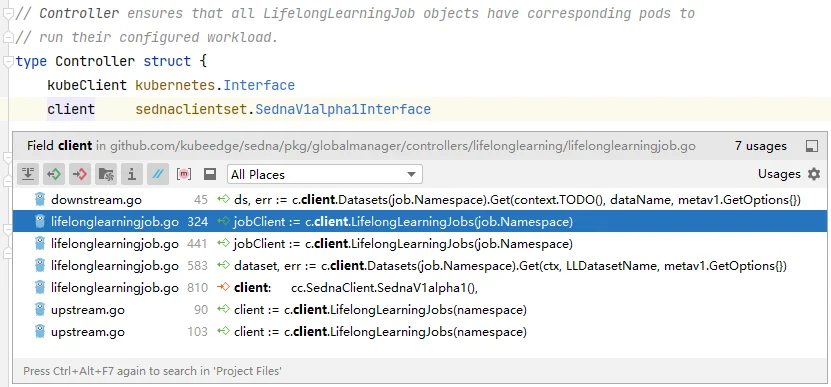
LifelongLearningJob Controller init uses that client. It:
- Gets the LifelongLearningJob Informer. Informer ≈ local cache of the api-server for this controller, to ease read pressure.
- Sets controller fields: k8s client, sedna client, shared GM config.
- Binds Add / Update / Delete callbacks on the CR.
pkg/globalmanager/controllers/lifelonglearning/lifelonglearningjob.go
// New creates a new LifelongLearningJob controller that keeps the relevant pods
// in sync with their corresponding LifelongLearningJob objects.
func New(cc *runtime.ControllerContext) (runtime.FeatureControllerI, error) {
   cfg := cc.Config

   podInformer := cc.KubeInformerFactory.Core().V1().Pods()

   // 获取LifelongLearningJob的Informer
   jobInformer := cc.SednaInformerFactory.Sedna().V1alpha1().LifelongLearningJobs()

   eventBroadcaster := record.NewBroadcaster()
   eventBroadcaster.StartRecordingToSink(&v1core.EventSinkImpl{Interface: cc.KubeClient.CoreV1().Events("")})

   // 配置LifelongLearningJob Controller的参数
   jc := &Controller{
      kubeClient: cc.KubeClient,
      client:     cc.SednaClient.SednaV1alpha1(),
      queue:      workqueue.NewNamedRateLimitingQueue(workqueue.NewItemExponentialFailureRateLimiter(runtime.DefaultBackOff, runtime.MaxBackOff), Name),
      cfg:        cfg,
   }

   // 绑定LifelongLearningJob CRD资源的Add、Update、Delete对应事件的回调函数。
   jobInformer.Informer().AddEventHandler(cache.ResourceEventHandlerFuncs{
      AddFunc: func(obj interface{}) {
         jc.enqueueController(obj, true)
         jc.syncToEdge(watch.Added, obj)
      },
      UpdateFunc: func(old, cur interface{}) {
         jc.enqueueController(cur, true)
         jc.syncToEdge(watch.Added, cur)
      },
      DeleteFunc: func(obj interface{}) {
         jc.enqueueController(obj, true)
         jc.syncToEdge(watch.Deleted, obj)
      },
   })
   jc.jobLister = jobInformer.Lister()
   jc.jobStoreSynced = jobInformer.Informer().HasSynced

   // 绑定Pod对应的增删改对应事件的回调函数。
   podInformer.Informer().AddEventHandler(cache.ResourceEventHandlerFuncs{
      AddFunc:    jc.addPod,
      UpdateFunc: jc.updatePod,
      DeleteFunc: jc.deletePod,
   })
   jc.podStore = podInformer.Lister()
   jc.podStoreSynced = podInformer.Informer().HasSynced

   return jc, nil
}
Sedna CRD client used from other modules too:
[5] Message handling init
uc.Run() inits UpstreamController, which handles all messages from the edge.
A for-loop listens on context.upstreamChannel. On a message, uc.updateHandlers[kind] picks the handler and calls it. The map holds handlers for joint infer, incremental, federated, lifelong.
pkg/globalmanager/controllers/upstream.go
// syncEdgeUpdate receives the updates from edge and syncs these to k8s.
func (uc *UpstreamController) syncEdgeUpdate() {
   for {
      select {
      case <-uc.messageLayer.Done():
         klog.Info("Stop sedna upstream loop")
         return
      default:
      }

      update, err := uc.messageLayer.ReceiveResourceUpdate()
  ...

      handler, ok := uc.updateHandlers[kind]
      if ok {
         err := handler(name, namespace, operation, update.Content)
         ...
      }
   }
}
ReceiveFromEdge is a blocking channel for messages from the edge LC, type nodeMessage.
pkg/globalmanager/messagelayer/ws/context.go
// ReceiveResourceUpdate receives and handles the update
func (cml *ContextMessageLayer) ReceiveResourceUpdate() (*ResourceUpdateSpec, error) {
   nodeName, msg, err := wsContext.ReceiveFromEdge()
   ...
}
[6] Controller registry
NewRegistry() registers every feature’s New. Adding a new cloud–edge feature means adding a New here.
pkg/globalmanager/controllers/registry.go
func NewRegistry() Registry {
   return Registry{
      ji.Name:      ji.New,
      fe.Name:      fe.New,
      fl.Name:      fl.New,
      il.Name:      il.New,
      ll.Name:      ll.New,
      reid.Name:    reid.New,
      va.Name:      va.New,
      dataset.Name: dataset.New,
      objs.Name:    objs.New,
   }
}
[7] Cloud → edge sync
f.SetDownstreamSendFunc() binds each feature’s syncToEdge().
For lifelong learning:
- Get the node named on the Dataset CR.
- Get train / eval / deploy node names from annotations.
- Depending on job stage, send to different nodes.
pkg/globalmanager/controllers/lifelonglearning/downstream.go
func (c *Controller) syncToEdge(eventType watch.EventType, obj interface{}) error {

   // 获取到对应的数据集指定的节点(Dataset CRD对象中有一个字段记录了Node名称)
   ds, err := c.client.Datasets(job.Namespace).Get(context.TODO(), dataName, metav1.GetOptions{})

   // 获取到训练、评估、部署对应的节点名称
   getAnnotationsNodeName := func(nodeName sednav1.LLJobStage) string {
      return runtime.AnnotationsKeyPrefix + string(nodeName)
   }
   ann := job.GetAnnotations()
   if ann != nil {
      trainNodeName = ann[getAnnotationsNodeName(sednav1.LLJobTrain)]
      evalNodeName = ann[getAnnotationsNodeName(sednav1.LLJobEval)]
      deployNodeName = ann[getAnnotationsNodeName(sednav1.LLJobDeploy)]
   }

   ...

   // 根据LifelongLearningJob所处阶段不同,发送消息到不同的节点上
   switch jobStage {
   case sednav1.LLJobTrain:
      doJobStageEvent(trainNodeName)
   case sednav1.LLJobEval:
      doJobStageEvent(evalNodeName)
   case sednav1.LLJobDeploy:
      doJobStageEvent(deployNodeName)
   }

   return nil
}
[8] Edge → cloud sync
f.SetUpstreamHandler() binds each feature’s updateFromEdge().
For lifelong learning:
- Change overall LifelongLearningJob state from edge task completion.
- Write that state back to k8s, the CR Status.
- Parse the edge message (JSON). Example body:
Example GM receives:
{
    "phase": "train",
    "status": "completed",
    "output": {
        "models": [{
            "classes":  ["road", "fence"],
            "current_metric": null,
            "format": "pkl",
            "metrics": null,
            "url": "/output/train/1/index.pkl"
        }],
        "ownerInfo": null
    }
}
pkg/globalmanager/controllers/lifelonglearning/upstream.go
// updateFromEdge syncs the edge updates to k8s
func (c *Controller) updateFromEdge(name, namespace, operation string, content []byte) error {
   var jobStatus struct {
      Phase  string `json:"phase"`
      Status string `json:"status"`
   }

   // 把边缘消息结构体进行解析。
   err := json.Unmarshal(content, &jobStatus)
   ...
   cond := sednav1.LLJobCondition{
      Status:             v1.ConditionTrue,
      LastHeartbeatTime:  metav1.Now(),
      LastTransitionTime: metav1.Now(),
      Data:               string(condDataBytes),
      Message:            "reported by lc",
   }

   // 根据不同的边缘节点任务状态实现,变更当前LifelongLearningJob的整体状态
   switch strings.ToLower(jobStatus.Status) {
   case "ready":
      cond.Type = sednav1.LLJobStageCondReady
   case "completed":
      cond.Type = sednav1.LLJobStageCondCompleted
   case "failed":
      cond.Type = sednav1.LLJobStageCondFailed
   case "waiting":
      cond.Type = sednav1.LLJobStageCondWaiting
   default:
      return fmt.Errorf("invalid condition type: %v", jobStatus.Status)
   }

   // 将当前LifelongLearningJob的整体状态写回k8s,也就是LifelongLearningJob这个CR的Status字段。
   err = c.appendStatusCondition(name, namespace, cond)
   ...
}
[9] Controller core
f.run() runs each feature controller. LifelongLearningJob’s run():
WaitForNamedCacheSync until Pod and LifelongLearningJob are in the Informer. Then start N workers.
pkg/globalmanager/controllers/lifelonglearning/lifelonglearningjob.go
// Run starts the main goroutine responsible for watching and syncing jobs.
func (c *Controller) Run(stopCh <-chan struct{}) {
   workers := 1

   defer utilruntime.HandleCrash()
   defer c.queue.ShutDown()

   klog.Infof("Starting %s controller", Name)
   defer klog.Infof("Shutting down %s controller", Name)

   if !cache.WaitForNamedCacheSync(Name, stopCh, c.podStoreSynced, c.jobStoreSynced) {
      klog.Errorf("failed to wait for %s caches to sync", Name)

      return
   }
   klog.Infof("Starting %s workers", Name)
   for i := 0; i < workers; i++ {
      go wait.Until(c.worker, time.Second, stopCh)
   }

   <-stopCh
}
c.worker calls processNextWorkItem() on each job.
pkg/globalmanager/controllers/lifelonglearning/lifelonglearningjob.go
// worker runs a worker thread that just dequeues items, processes them, and marks them done.
// It enforces that the syncHandler is never invoked concurrently with the same key.
func (c *Controller) worker() {
   for c.processNextWorkItem() {
   }
}
processNextWorkItem() calls c.sync() for feature logic.
pkg/globalmanager/controllers/lifelonglearning/lifelonglearningjob.go
func (c *Controller) sync(key string) (bool, error) {
   //省略了部分代码
   ns, name, err := cache.SplitMetaNamespaceKey(key)

   sharedJob, err := c.jobLister.LifelongLearningJobs(ns).Get(name)

   // if job was finished previously, we don't want to redo the termination
   if IsJobFinished(&job) {
      return true, nil
   }

   // transit this job's state machine
   needUpdated, err = c.transitJobState(&job)


   if needUpdated {
      if err := c.updateJobStatus(&job); err != nil {
         return forget, err
      }

      if jobFailed && !IsJobFinished(&job) {
         // returning an error will re-enqueue LifelongLearningJob after the backoff period
         return forget, fmt.Errorf("failed pod(s) detected for lifelonglearningjob key %q", key)
      }

      forget = true
   }

   return forget, err
}
sync on a concrete job:
SplitMetaNamespaceKey→ namespace and namec.jobListerfetches the objecttransitJobStatedecides train / eval / deploy- If Status changed,
c.updateJobStatus()writes back so kubectl shows current stage, model path, etc. - Failure handling
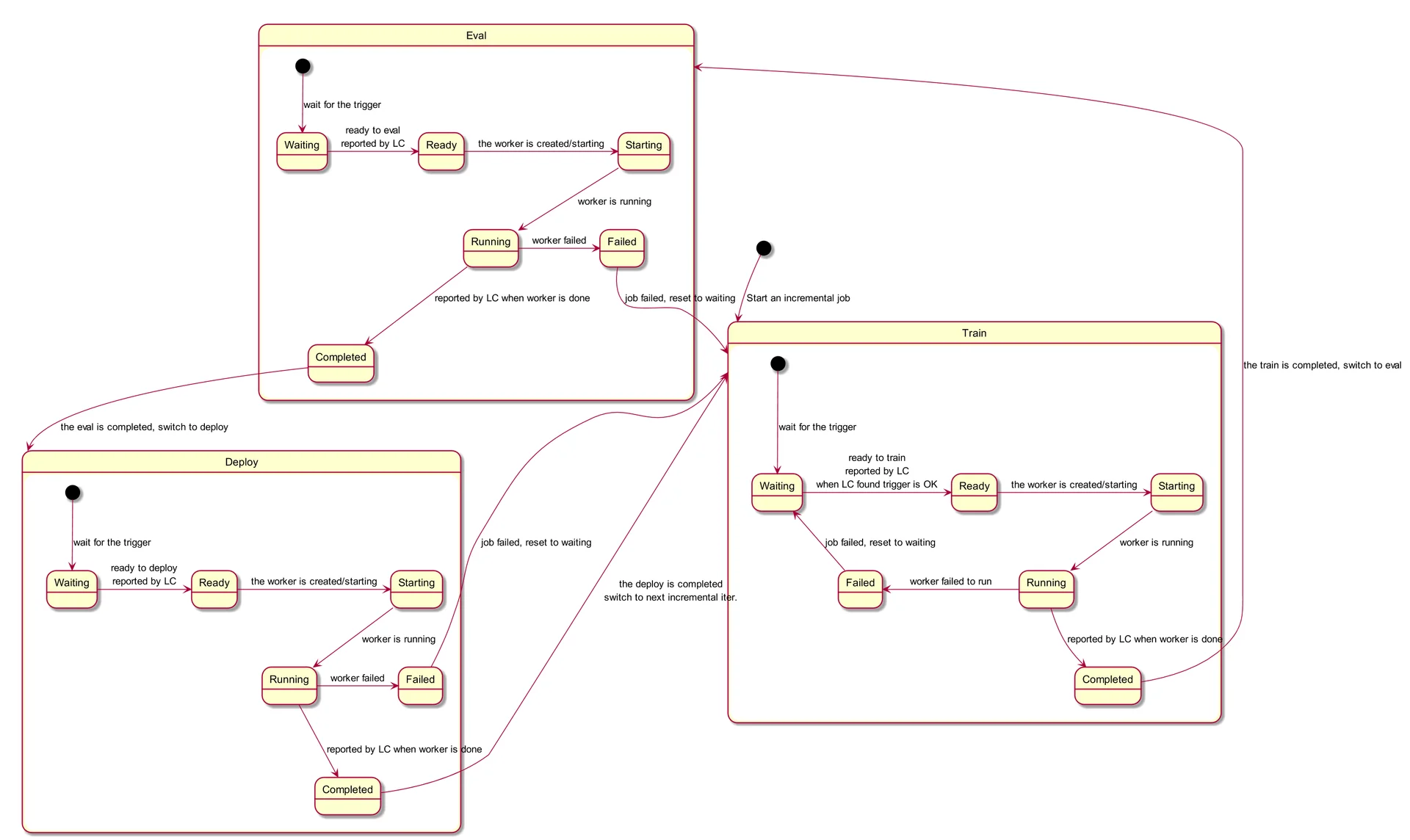
// transit this job's state machine
needUpdated, err = c.transitJobState(&job)
transitJobState() is the state machine: when train / eval / deploy start and stop. See the diagram:
[10] websocket listen
A websocket for the edge messages from [8], default 0.0.0.0:9000.
pkg/globalmanager/controllers/manager.go
addr := fmt.Sprintf("%s:%d", m.Config.WebSocket.Address, m.Config.WebSocket.Port)

ws := websocket.NewServer(addr)
err = ws.ListenAndServe()
LC: Local Controller
LC runs on the edge: local job management and a message proxy. Entry cmd/sedna-lc/sedna-lc.go; see the GM section for a similar entry. Local job-manager registration:
cmd/sedna-lc/app/server.go
// runServer runs server
func runServer() {
   c := gmclient.NewWebSocketClient(Options)
   if err := c.Start(); err != nil {
      return
   }

   dm := dataset.New(c, Options)
   mm := model.New(c)
   jm := jointinference.New(c)
   fm := federatedlearning.New(c)
   im := incrementallearning.New(c, dm, mm, Options)
   lm := lifelonglearning.New(c, dm, Options)
   s := server.New(Options)

   for _, m := range []managers.FeatureManager{
      dm, mm, jm, fm, im, lm,
   } {
      s.AddFeatureManager(m)
      c.Subscribe(m)
      err := m.Start()
      if err != nil {
         klog.Errorf("failed to start manager %s: %v",
            m.GetName(), err)
         return
      }
      klog.Infof("manager %s is started", m.GetName())
   }

   s.ListenAndServe()
}
Local job management
Manager does edge job management. Shape:
pkg/localcontroller/managers/lifelonglearning/lifelonglearningjob.go
// LifelongLearningJobManager defines lifelong-learning-job Manager
type Manager struct {
   Client                 clienttypes.ClientI
   WorkerMessageChannel   chan workertypes.MessageContent
   DatasetManager         *dataset.Manager
   LifelongLearningJobMap map[string]*Job
   VolumeMountPrefix      string
}startJob():
- Watch Dataset objects synced to the edge; e.g. sample count hits a threshold → start train.
- By current stage, trigger train / eval / deploy. The edge does not start those jobs itself; it reports status to GM, GM schedules them.
pkg/localcontroller/managers/lifelonglearning/lifelonglearningjob.go
// startJob starts a job
func (lm *Manager) startJob(name string) {
   ...

   // 监控并处理同步到边缘的Dataset对象。
   go lm.handleData(job)

   tick := time.NewTicker(JobIterationIntervalSeconds * time.Second)
   for {
      // 根据当前任务不同阶段,触发不同阶段的训练、评估、部署任务。
      select {
      case <-job.JobConfig.Done:
         return
      case <-tick.C:
         cond := lm.getLatestCondition(job)
         jobStage := cond.Stage

         switch jobStage {
         case sednav1.LLJobTrain:
            err = lm.trainTask(job)
         case sednav1.LLJobEval:
            err = lm.evalTask(job)

         case sednav1.LLJobDeploy:
            err = lm.deployTask(job)
         default:
            klog.Errorf("invalid phase: %s", jobStage)
            continue
         }
 ...
      }
   }
}
Besides the flow: dataset watch, model download, local DB backup of jobs, etc.
Message proxy
Besides pushing status to the cloud, LC starts an HTTP server on 0.0.0.0:9100 that takes messages from the Lib, folds them, and sends them to GM. Routes and handler:
pkg/localcontroller/server/server.go
// register registers api
func (s *Server) register(container *restful.Container) {
ws := new(restful.WebService)
ws.Path(fmt.Sprintf("/%s", constants.ServerRootPath)).
Consumes(restful.MIME_XML, restful.MIME_JSON).
Produces(restful.MIME_JSON, restful.MIME_XML)

ws.Route(ws.POST("/workers/{worker-name}/info").
To(s.messageHandler).
Doc("receive worker message"))
container.Add(ws)
}
pkg/localcontroller/server/server.go
// messageHandler handles message from the worker
func (s *Server) messageHandler(request *restful.Request, response *restful.Response) {
   var err error
   workerName := request.PathParameter("worker-name")
   workerMessage := workertypes.MessageContent{}

   err = request.ReadEntity(&workerMessage)
   if workerMessage.Name != workerName || err != nil {
      var msg string
      if workerMessage.Name != workerName {
         msg = fmt.Sprintf("worker name(name=%s) in the api is different from that(name=%s) in the message body",
            workerName, workerMessage.Name)
      } else {
         msg = fmt.Sprintf("read worker(name=%s) message body failed, error: %v", workerName, err)
      }

      klog.Errorf(msg)
      err = s.reply(response, http.StatusBadRequest, msg)
      if err != nil {
         klog.Errorf("reply messge to worker(name=%s) failed, error: %v", workerName, err)
      }
   }

   if m, ok := s.fmm[workerMessage.OwnerKind]; ok {
      m.AddWorkerMessage(workerMessage)
   }

   err = s.reply(response, http.StatusOK, "OK")
   if err != nil {
      klog.Errorf("reply message to worker(name=%s) failed, error: %v", workerName, err)
      return
   }
}
Sedna Lib source (Python)
Lib is a Python library for AI / app developers, so you can turn existing code into cloud–edge collab.
Layout:
➜  sedna tree lib -L 2
lib
├── __init__.py
├── MANIFEST.in
├── OWNERS
├── requirements.dev.txt
├── requirements.txt    // Sedna Python的依赖
├── sedna
│   ├── algorithms  // 边云协同算法
│   ├── backend     // 支持的后端,tensorflow/pytorch
│   ├── common
│   ├── core        // 主要特性的实现逻辑
│   ├── datasources // 支持的数据源格式,比如txt、csv等
│   ├── __init__.py
│   ├── README.md
│   ├── service     // 需要启动server的组件,比如kb等
│   ├── VERSION
│   └── __version__.py
└── setup.py
Typical bits from each part:
core
core wraps user callbacks. train below mainly calls the user’s tensorflow / pytorch / mindspore train.
- Configure post-process.
- Call the cloud knowledge base for train / infer.
- Update the cloud KB. In lifelong learning the KB holds new models and samples and keeps changing.
- Report the train job to LC — done or not, metrics after train.
lib/sedna/core/lifelong_learning/lifelong_learning.py
def train(self, train_data,
          valid_data=None,
          post_process=None,
          **kwargs):
    is_completed_initilization = \
        str(Context.get_parameters("HAS_COMPLETED_INITIAL_TRAINING",
                                   "false")).lower()

    if is_completed_initilization == "true":
        return self.update(train_data,
                           valid_data=valid_data,
                           post_process=post_process,
                           **kwargs)

    # 配置后处理函数
    callback_func = None
    if post_process is not None:
        callback_func = ClassFactory.get_cls(
            ClassType.CALLBACK, post_process)
    res, seen_task_index = \
        self.cloud_knowledge_management.seen_estimator.train(
            train_data=train_data,
            valid_data=valid_data,
            **kwargs
        )

    # 调用云端知识库进行训练、或推理
    unseen_res, unseen_task_index = \
        self.cloud_knowledge_management.unseen_estimator.train()

    # 更新云端知识库
    task_index = dict(
        seen_task=seen_task_index,
        unseen_task=unseen_task_index)
    task_index_url = FileOps.dump(
        task_index, self.cloud_knowledge_management.local_task_index_url)

    task_index = self.cloud_knowledge_management.update_kb(task_index_url)
    res.update(unseen_res)

    ...

    # 将当前训练任务执行的情况发送给LC,比如训练任务是否完成、训练后的指标是多少
    self.report_task_info(
            None, K8sResourceKindStatus.COMPLETED.value, task_info_res)
        self.log.info(f"Lifelong learning Train task Finished, "
                      f"KB index save in {task_index}")
        return callback_func(self.estimator, res) if callback_func else res

    ...
backend
MSBackend is a Sedna-supported backend, MindSpore. If a framework has typical train / predict / evaluate, Sedna Lib can take it as a backend and wrap existing AI code for cloud–edge.
lib/sedna/backend/mindspore/__init__.py
class MSBackend(BackendBase):
    def __init__(self, estimator, fine_tune=True, **kwargs):
        super(MSBackend, self).__init__(estimator=estimator,
                                        fine_tune=fine_tune,
                                        **kwargs)
        self.framework = "mindspore"
        if self.use_npu:
            context.set_context(mode=context.GRAPH_MODE,
                                device_target="Ascend")
        elif self.use_cuda:
            context.set_context(mode=context.GRAPH_MODE,
                                device_target="GPU")
        else:
            context.set_context(mode=context.GRAPH_MODE,
                                device_target="CPU")

        if callable(self.estimator):
            self.estimator = self.estimator()

    def train(self, train_data, valid_data=None, **kwargs):
        if callable(self.estimator):
            self.estimator = self.estimator()
        if self.fine_tune and FileOps.exists(self.model_save_path):
            self.finetune()
        self.has_load = True
        varkw = self.parse_kwargs(self.estimator.train, **kwargs)
        return self.estimator.train(train_data=train_data,
                                    valid_data=valid_data,
                                    **varkw)

    def predict(self, data, **kwargs):
        if not self.has_load:
            self.load()
        varkw = self.parse_kwargs(self.estimator.predict, **kwargs)
        return self.estimator.predict(data=data, **varkw)

    def evaluate(self, data, **kwargs):
        if not self.has_load:
            self.load()
        varkw = self.parse_kwargs(self.estimator.evaluate, **kwargs)
        return self.estimator.evaluate(data, **varkw)
datasource
datasource wraps common dataset-format parsers, so you don’t have to
lib/sedna/datasources/__init__.py
class CSVDataParse(BaseDataSource, ABC):
    """
    csv file which contain Structured Data parser
    """
    # 提供了方便的数据集解析函数,
    def parse(self, *args, **kwargs):
        x_data = []
        y_data = []
        label = kwargs.pop("label") if "label" in kwargs else ""
        usecols = kwargs.get("usecols", "")
        if usecols and isinstance(usecols, str):
            usecols = usecols.split(",")
        if len(usecols):
            if label and label not in usecols:
                usecols.append(label)
            kwargs["usecols"] = usecols
        for f in args:
            if isinstance(f, (dict, list)):
                res = self.parse_json(f, **kwargs)
            else:
                if not (f and FileOps.exists(f)):
                    continue
                res = pd.read_csv(f, **kwargs)
            if self.process_func and callable(self.process_func):
                res = self.process_func(res)
            if label:
                if label not in res.columns:
                    continue
                y = res[label]
                y_data.append(y)
                res.drop(label, axis=1, inplace=True)
            x_data.append(res)
        if not x_data:
            return
        self.x = pd.concat(x_data)
        self.y = pd.concat(y_data)
algorithms
Cloud–edge AI needs algorithms for that setting. Sedna ships a few hard-example miners, e.g. the cross-entropy threshold below, which can flag samples when the edge model is not confident.
The point isn’t only to ship those basics — it’s to let the cloud–edge framework grow more practical algorithms that improve train/infer overall. That’s what this Lib shape is for.
lib/sedna/algorithms/hard_example_mining/hard_example_mining.py
@ClassFactory.register(ClassType.HEM, alias="CrossEntropy")
class CrossEntropyFilter(BaseFilter, abc.ABC):
    """
    **Object detection** Hard samples discovery methods named `CrossEntropy`

    Parameters
    ----------
    threshold_cross_entropy: float
        hard coefficient threshold score to filter img, default to 0.5.
    """

    def __init__(self, threshold_cross_entropy=0.5, **kwargs):
        self.threshold_cross_entropy = float(threshold_cross_entropy)

    def __call__(self, infer_result=None) -> bool:
        """judge the img is hard sample or not.

        Parameters
        ----------
        infer_result: array_like
            prediction classes list, such as
            [class1-score, class2-score, class2-score,....],
            where class-score is the score corresponding to the class,
            class-score value is in [0,1], who will be ignored if its
            value not in [0,1].

        Returns
        -------
        is hard sample: bool
            `True` means hard sample, `False` means not.
        """

        if not infer_result:
            # if invalid input, return False
            return False

        log_sum = 0.0
        data_check_list = [class_probability for class_probability
                           in infer_result
                           if self.data_check(class_probability)]

        if len(data_check_list) != len(infer_result):
            return False

        for class_data in data_check_list:
            log_sum += class_data * math.log(class_data)
        confidence_score = 1 + 1.0 * log_sum / math.log(
            len(infer_result))
        return confidence_score < self.threshold_cross_entropy